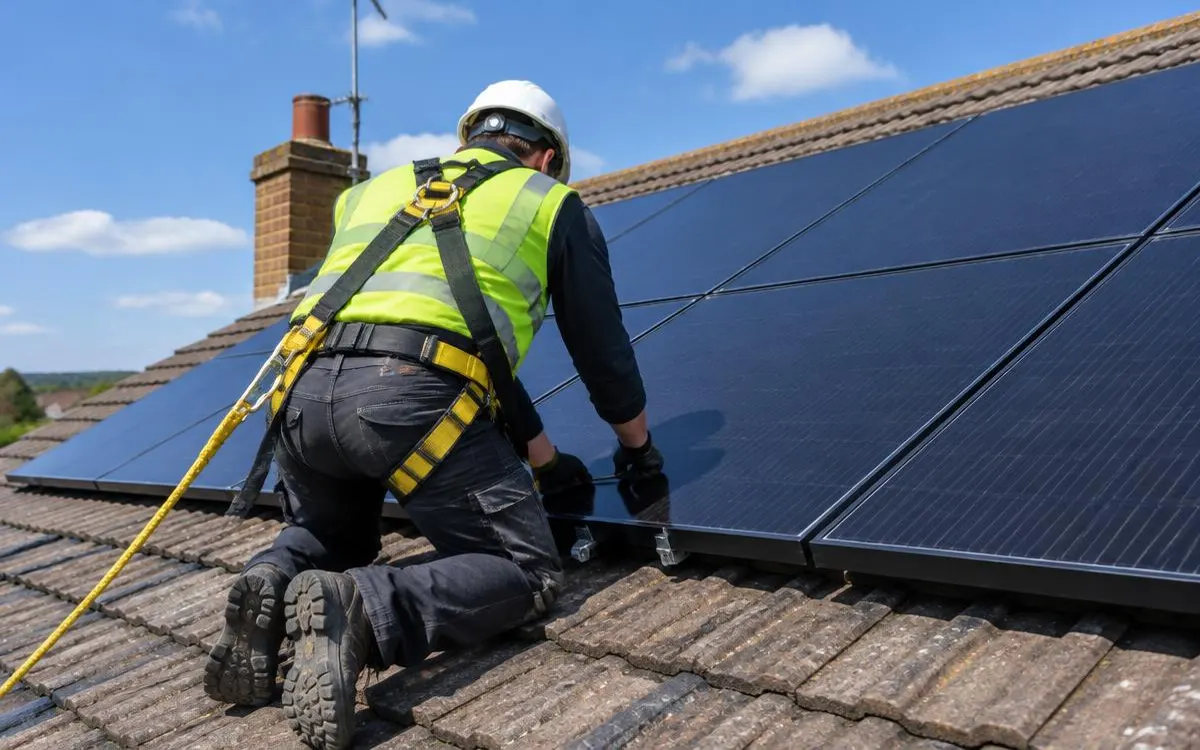
Compare panel technology separately from the way a solar array is fitted to your property. Monocrystalline, polycrystalline and thin-film describe different panel constructions, while mounting describes the installation arrangement. Neither label alone tells you which proposal suits your home. Ask an MCS-certified installer to connect the equipment choice to the surveyed roof, available space and design.
For the broader overview, read our guide: Solar Arrays UK.
Independent guide. We are not a lender or a government body. Always check current scheme rules with the official provider.
1. Separate panel construction from installation layout
Monocrystalline panels use cells made from single-crystal silicon, while polycrystalline cells contain multiple silicon crystals. Thin-film panels use thin layers of photovoltaic material rather than the same crystalline cell construction. These descriptions explain product families, not the performance of every model in them. Compare the actual equipment datasheets and written design rather than choosing from a label alone.
Ask which panel models the installer proposes and why they fit the available area. Product dimensions, appearance, mounting requirements and warranty conditions can differ within a panel family. A comparison of technology names cannot replace those specific details. Request an explanation of any alternative if the installer offers several equipment choices.
An on-roof array sits above the existing roof covering, while an integrated arrangement forms part of the roof system. Ground-mounted panels use a separate structure away from the roof. Each arrangement raises different questions about access, siting and the work needed. Keep those questions separate from the construction of the panels themselves.
- Identify the panel family and exact model in each proposal.
- Identify whether the array is on-roof, integrated or ground-mounted.
- Ask how both choices respond to the property survey and proposed work.
2. Compare qualitative strengths and trade-offs
The table gives questions to explore, not a ranking or a set of guaranteed outcomes. Specific products and installation designs matter more than broad claims about a whole category. Ask the installer to explain each trade-off using the proposed equipment and your property. No efficiency percentage or price comparison is implied by these descriptions.
| Type | Potential fit or advantage | Trade-off to check |
|---|---|---|
| Monocrystalline | A crystalline panel option to compare within the design | Exact model, dimensions, appearance and warranty |
| Polycrystalline | Another crystalline construction where a suitable product is proposed | Actual product specification rather than assumptions about the label |
| Thin-film | A different construction for a design with suitable equipment | Mounting requirements and suitability of the specific product |
| Roof-integrated | Panels form part of the roof arrangement | Roofing responsibilities, weatherproofing and later access |
| On-roof | Panels fitted above the roof covering | Roof condition, access and the mounting design |
| Ground-mounted | An option where suitable land and siting are available | Space, shading, planning and connection arrangements |
For roof-integrated work, ask who takes responsibility for the complete roof arrangement and any related warranty. For an on-roof proposal, confirm that existing repairs happen before fitting. For a ground-mounted design, check the position, access and connection route as well as the equipment. Do not assume a mounting choice removes the need for planning or network checks.
3. Choose from a complete written proposal
Ask for a survey-based explanation of the recommended layout, panel model and inverter. Compare the whole system rather than treating one equipment label as a guarantee of quality. Request separate details for any battery or optional accessory. Keep the design explanation with the itemised quote so you can compare alternatives consistently.
Check planning requirements with the local authority where the property or installation needs particular consideration. Confirm the installer's MCS details and relevant consumer protection before signing. Ask who handles installation faults and equipment claims after handover. Choose only when the product, roof or ground work and ongoing responsibilities are clear.
Checklist
- I know the panel family and exact model.
- I understand the mounting arrangement.
- I checked roof or ground-work responsibilities.
- I compared full system proposals.
- I understand warranties and access for repairs.
Frequently asked questions
Does my panel type determine its performance?
The technology label alone is not enough. Ask about the exact model and the complete design for your roof, shading and available space.
Can I use integrated panels when replacing my roof?
Ask the installer and roofer to assess the proposed arrangement together. Confirm roofing work, weatherproofing and warranty responsibilities in writing.
Will my ground-mounted array avoid planning checks?
Do not assume that. Check the specific siting and proposal with the local planning authority before proceeding.
How should I compare my equipment choices?
Compare exact model details, dimensions, warranties and the survey-based design. Avoid a decision based only on a panel family name.
So you can compare panel construction and installation layout as separate parts of a suitable design.
WHLS Editorial Team
Our editorial team writes independent, plain-English guides on home energy finance. We review guides when scheme rules change.
References
- Energy Saving Trust – Solar panels (opens in a new tab)
- Planning Portal – Solar equipment planning checks (opens in a new tab)
- GOV.UK – Register energy devices (opens in a new tab)
- Energy Saving Trust – Solar panel cleaning and maintenance (opens in a new tab)
- Electrical Safety First – Solar panels (opens in a new tab)
- MCS – Find an installer (opens in a new tab)
- Energy Saving Trust – Consumer protection (opens in a new tab)